
Independent quality assurance for reports and evidence being prepared for the NDIS — reviewed through an NDIS decision-making lens before they reach the NDIA.
You've completed the assessment.
You understand your participant.
You know what they need.
But does your report clearly demonstrate why they need it?
RDS Academy provides independent quality assurance for reports and supporting evidence being prepared for NDIS planning, reassessment and review processes.
With the perspective of a former NDIS Planner combined with current frontline Support Coordination experience, we identify opportunities to strengthen the evidence, reasoning, language and recommendations within your report before it is submitted.
A good clinical report isn't automatically a good NDIS report.
Practitioners are trained to be experts in their discipline.
They're not necessarily trained to write for the NDIS.
And they're two different skills.
A report can be clinically excellent while still leaving unanswered questions from an NDIS decision-making perspective.
The evidence might be there, but the connection isn't clear.
A recommendation might be entirely appropriate, but the justification hasn't made it onto the page.
Functional impacts might be described extensively without being clearly connected to the supports being recommended.
Or information that seems obvious to the practitioner may require the person reading the report to join the dots themselves.
When your report is being relied upon as evidence for an NDIS decision, those dots matter.
Knowing what someone needs isn't enough.
You have to evidence why.
Think about making any significant claim or request.
Knowing that something is needed is one thing. Demonstrating it with sufficient evidence is another.
The same principle applies when evidence is submitted to the NDIS.
A participant may genuinely require a particular support.
You may have strong professional reasoning for recommending it.
But the person making the decision wasn't in the assessment room with you. They haven't observed what you've observed, and they don't automatically know the reasoning that led you to your recommendation.
Your report has to communicate that for you.
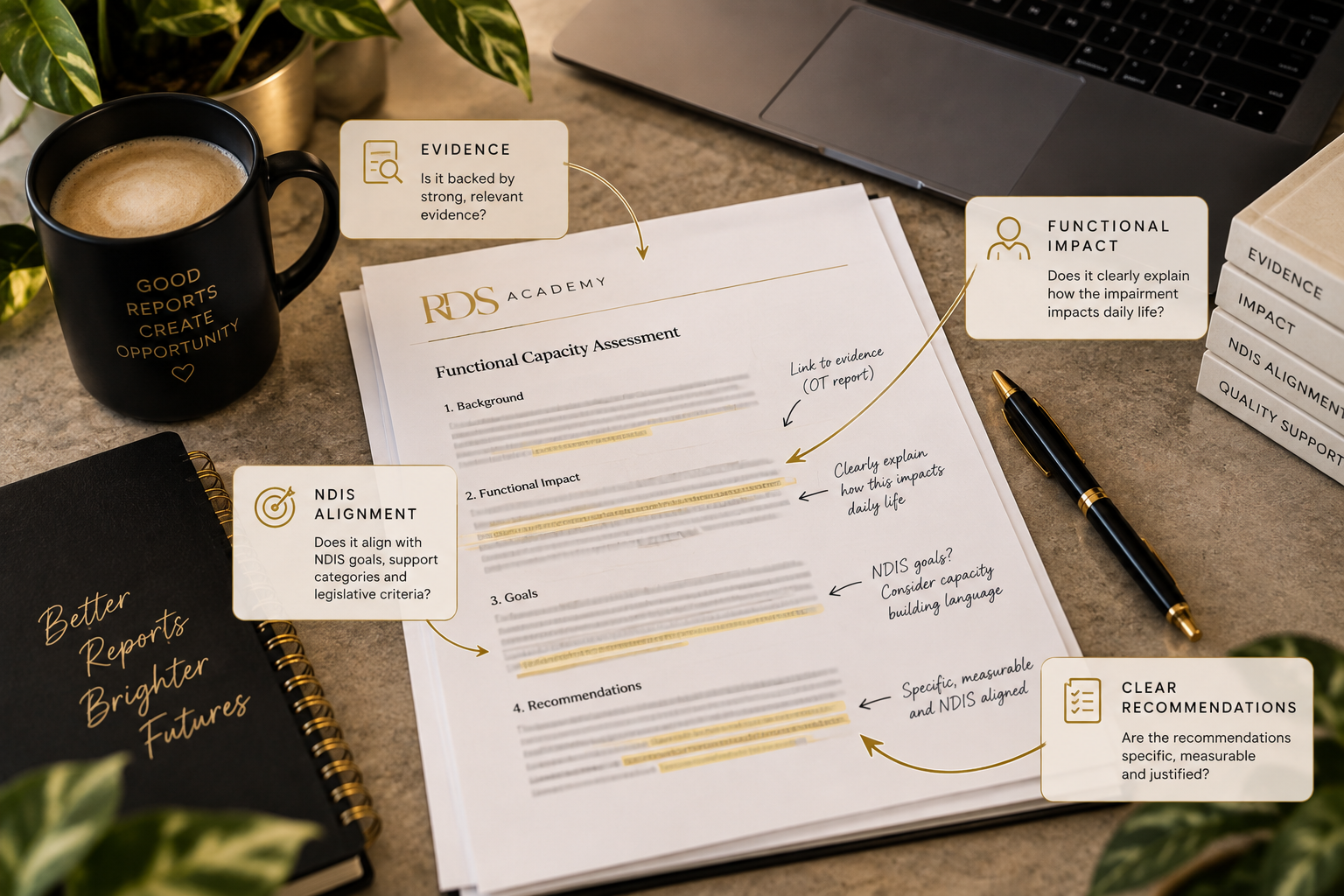
It needs to clearly demonstrate the participant's functional impact, support needs, assessment findings and the reasoning behind your recommendations.
It needs to connect the dots.
That's why writing for the NDIS is a skill in itself.
We see what happens after the report is submitted.
RDS Academy grew from the frontline experience of Rosie Disability Services.
As Support Coordinators, we spend a considerable amount of time reading reports and gathering evidence for participants.
We review reports in preparation for plan reassessments, changes in circumstances, internal reviews and other NDIS processes.
And too often, we receive a completed report and find ourselves going back to the practitioner.
Can you explain this further?
Can this recommendation be better justified?
Where is the evidence connecting this assessment result to the support being requested?
Can you clarify the functional impact?
What led you to recommend these hours?
We do this because we want the strongest possible evidence available for our participants.
But strengthening another professional's report shouldn't need to become the Support Coordinator's job.
And ideally, those gaps shouldn't be identified after the report has already been finalised.
They should be identified before it leaves the practitioner's desk.
That's why RDS Academy's Quality Assurance service exists.
Already have internal quality assurance?
Great. We don't replace it - add another lens.
Many organisations already have internal quality assurance processes, and that's a good thing.
Depending on the organisation, internal QA may consider clinical quality, organisational standards, required sections, report structure, templates, professional presentation, consistency and internal processes.
Some organisations also have senior clinicians or discipline leads reviewing clinical reasoning and recommendations.
Our service doesn't replace any of that.
But a report can successfully pass an organisation's internal quality assurance process and still leave important questions unanswered from an NDIS decision-making perspective.
That's the gap we're looking for.
We're not primarily asking whether the report follows your organisation's template.
We're asking:
If this report landed in front of an NDIS decision-maker tomorrow, what questions would I still have?
Does the evidence clearly demonstrate the participant's functional impact?
Can we follow the practitioner's reasoning from assessment findings through to the supports being recommended?
Does each recommendation follow NDIS guidelines and report writing expectations?
Are each recommendation clearly justified against the NDIS Act 2013?
Has information that's obvious to the practitioner actually been explained to someone who doesn't share their clinical expertise?
Passing internal QA and being fit for purpose as NDIS evidence are not necessarily the same thing.
RDS Academy provides an additional, independent review through a former NDIS Planner and current Support Coordination lens.
Your internal QA considers whether the report meets your organisation's standards.
We ask whether the report tells the NDIS what it needs to understand.
Reviewed through a Planner's lens.
Our Quality Assurance service brings together two perspectives that don't often sit together.
FORMER NDIS PLANNER EXPERIENCE
An understanding of how information and evidence may be considered within an NDIS decision-making environment — and the questions that can arise when evidence doesn't clearly tell the whole story.
CURRENT SUPPORT COORDINATION EXPERIENCE
An understanding of what happens after reports leave the practitioner's desk — how evidence is used in real planning and review processes, where gaps commonly appear and what can result in reports being sent back for clarification or amendment.
Together, these perspectives allow us to review the report from somewhere different to a traditional clinical or organisational QA process.
What are we looking for?
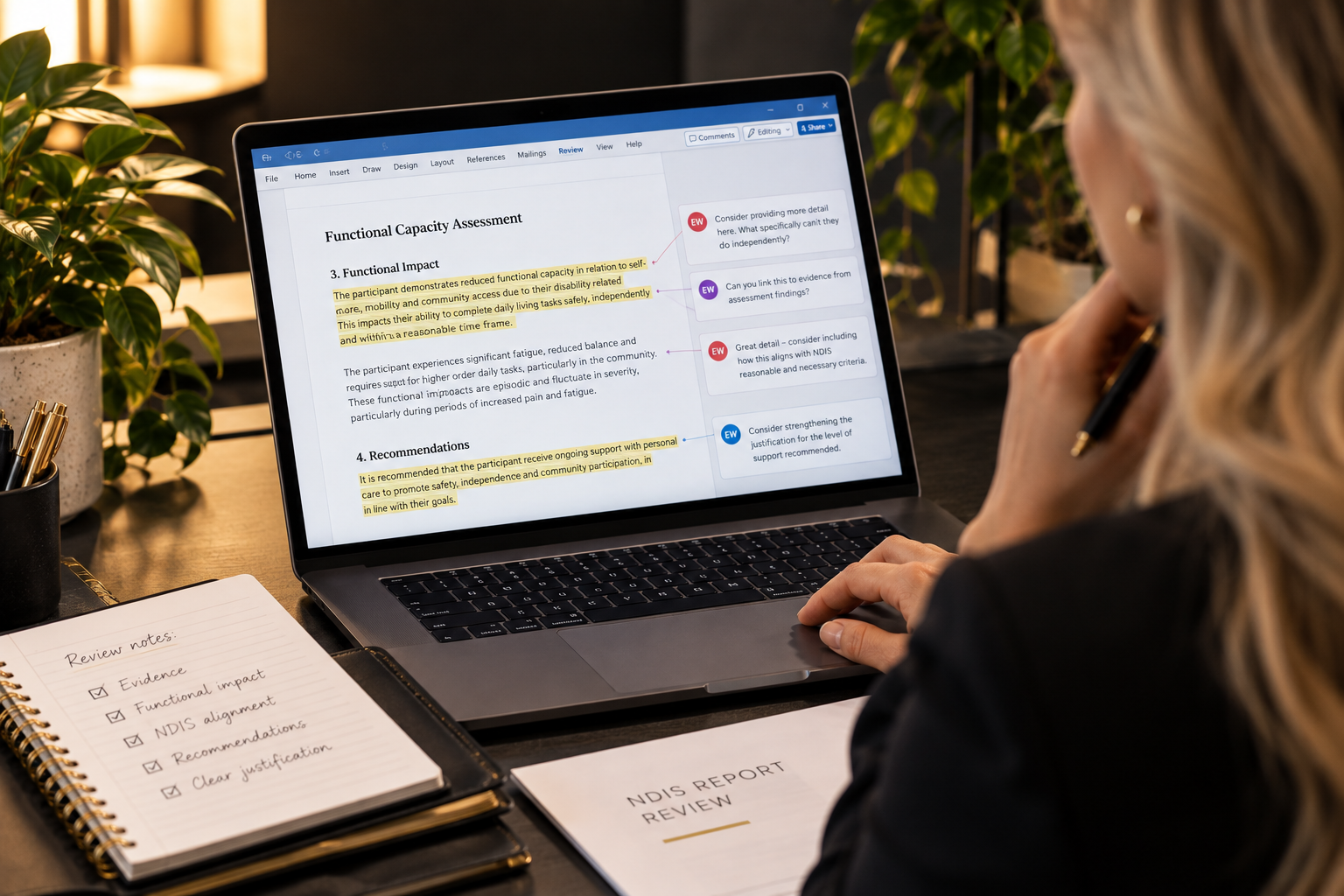
Evidence
Have the participant's disability-related functional impacts and support needs been clearly demonstrated?
Reasoning
Can the reader understand how the assessment findings have led to the conclusions and recommendations being made?
NDIS Relevance
Has professional and clinical information been translated into evidence that is relevant to the NDIS decision being considered?
Recommendations
Are recommendations clear, specific, evidence-based and adequately justified?
Connection
Does the report connect the assessment findings, functional impact, identified need and recommended support?
Or is the reader being expected to make those connections themselves?
Clarity
Could someone outside your discipline understand what you're saying, why it matters and what you're asking for?